
As a practicing computational architect and researcher, I’ve never viewed computation as a simple means of expediting conventional design processes. Rather, it is through the acceleration of conventional design processes that opportunities arise to understand more deeply the built environment that will emerge.
Computation opens new potentials for cross-consideration of metrics beyond the conventional “get it done” methodology.
Too often, the siloed AEC industry flattens the design process to two baseline metrics: cost and structure. Architecture is never just physical shelter—it is a dynamic, living organism embedded within a much larger ecosystem.
Leveraging computational tools allows us to layer deeper intelligence into the creative process right from day one, mapping the environment we build in through:
Natural Interactivity: Uncovering simple, elegant design modifications that allow a building to passively adapt to light, wind, and microclimates—working with nature rather than in opposition to it.
Socio-Cultural Layers: Mapping the social texture and cultural context of a neighborhood to ensure the intervention genuinely serves its community.
Material Flows: Tracking resource lifecycles and availability, measuring embodied carbon, and designing with circularity in mind to build responsibly.
Predictive Simulations: Modeling long-term environmental, performance and operational outcomes to understand how a building, built to last, will perform decades down the line.
The Paradigm Shift: From Parametric Scripting to Neural Networks
For decades, computational design was restricted to customized parametric models and single-point solutions. While revolutionary for their time, these workflows were largely siloed—heavy, slow, and designed to solve one isolated variable at a time.
Today, we are reaching a critical inflection point.
We are transitioning away from those fragmented, single-solution tools toward developing AI frameworks and neural networks capable of cross-referencing multi-dimensional databases simultaneously. Rather than running linear, time-consuming simulations, machine learning allows us to achieve true multi-objective optimization—synthesizing real-time microclimate data, material lifecycles, social contexts, and spatial performance all at once.
When we integrate these intelligent networks into the early studio workflow, we don't end up with bloated complexity. We arrive at simple, highly informed, and contextually grounded architecture.
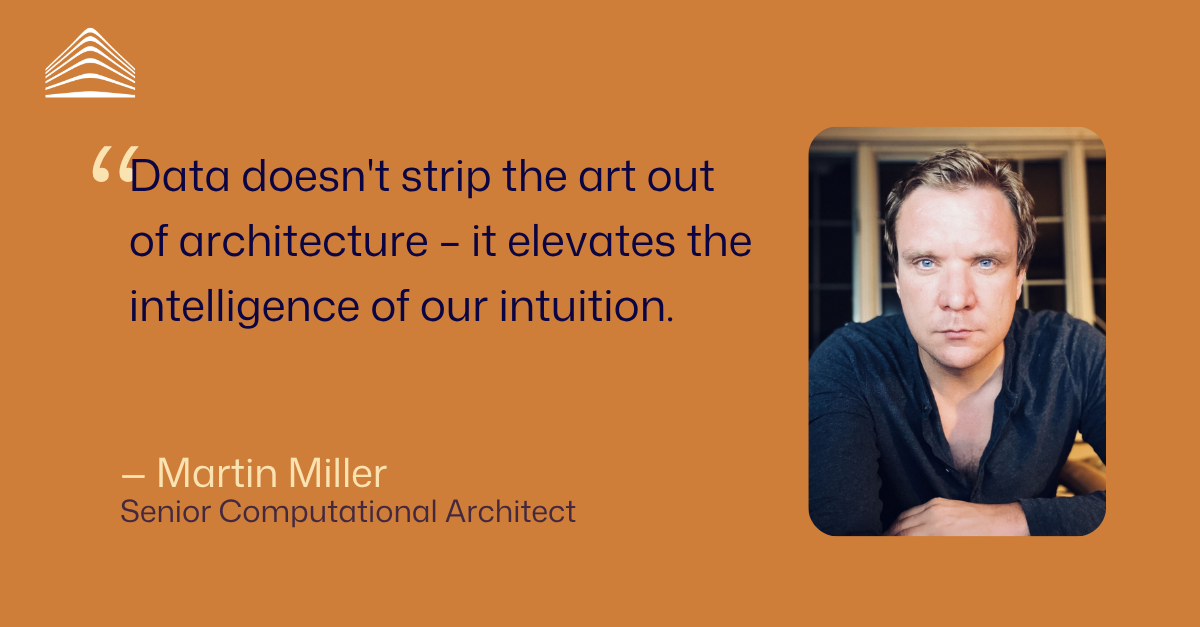
Data doesn't strip the art out of architecture—it elevates the intelligence of our intuition.